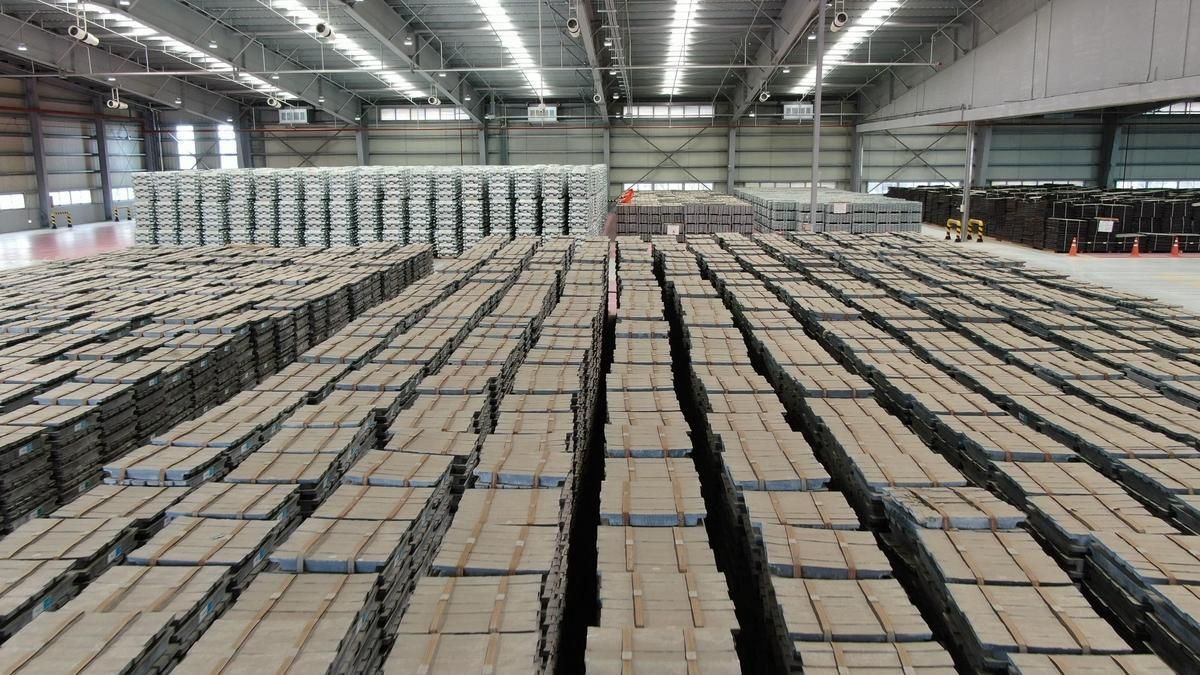
Critical Raw Material Stockpiles as Part of the State’s Secure Functioning
Position of the Critical Infrastructure Association of the Slovak Republic on the German Chancellor’s call to establish European stockpiles of critical raw materials
At an economic conference in Berlin on 5 November 2026, German Chancellor Friedrich Merz said that Europe must build up stockpiles of critical raw materials to reduce its dependence on countries that dominate their extraction and processing. Without these materials, he said, it is impossible to manufacture batteries, high-performance electric motors or advanced semiconductors. The state should help diversify sources, support recycling and establish stockpiles at the European level (Štandard).
The Critical Infrastructure Association of the Slovak Republic (AKI SR) welcomes this initiative. It cautions, however, that stockpiles alone cannot ensure security. If the debate remains focused solely on the volume of raw materials held in storage, it will miss its most important potential: a comprehensive approach to the resilience of critical entities that keep the state functioning today.
The Right Direction, but More Is Needed
The issue of establishing European stockpiles of critical raw materials is highly relevant. The European Commission’s announcement last month that it had selected 46 strategic projects for faster permitting and funding support is consistent with the approach the association has long advocated.
We support this direction. However, for stockpiles to fulfil their purpose, three further issues need to be addressed.
First, the concepts must be distinguished. A raw material stockpile is static; resilience is dynamic. For a critical infrastructure operator, what matters is not how many tonnes of copper are held in a European warehouse, but how many hours it can continue providing an essential service if supplies are disrupted.
Second, there is the national dimension. The article speaks of Europe, but measures are implemented in the Member States. Slovakia has had Act No. 367/2024 Coll. on Critical Infrastructure in force since 1 January 2025. The Act transposes the CER Directive, and critical entities have already been designated. They - not Brussels - will be on the front line when a delivery is delayed.
Third, there is the methodology. Decisions about stockpiles can only be made meaningfully on the basis of risk assessments conducted at the level of a specific entity and a specific service. Without such assessments, the result will be a warehouse that is expensive, full and stocked with the wrong materials in a crisis.
The European Framework and the Reality of Supply Dependencies
This debate is neither new nor without a legal basis. Regulation (EU) 2024/1252 - the Critical Raw Materials Act (CRMA) - has been in force since 23 May 2024. It identifies 34 critical raw materials, 17 of which are strategic. By 2030, it sets four benchmarks: extraction equal to at least 10% of the EU’s annual consumption; processing equal to at least 40%; recycling equal to at least 25%; and diversification so that no single third country supplies more than 65% of the EU’s consumption of any given strategic raw material (European Commission, EUR-Lex).
Supply is highly concentrated: 100% of the rare earths used in permanent magnets are refined in China; 97% of the EU’s magnesium comes from China; 77% of its gallium comes from China; and 98% of its borates come from Türkiye.
The second fact is the experience of export restrictions. In 2023, China introduced export controls on gallium, germanium and graphite, followed by antimony in September 2024. In December 2023, it banned exports of technologies used to process rare earths. The price of gallium in Europe nearly doubled after the first of these measures. This provides empirical grounds for the debate on stockpiles.
The third fact is the most important: the CRMA already includes a stockpiling mechanism, but in the form of coordination rather than an obligation. The framework provides for supply-chain stress tests every three years and coordination of strategic stockpiles between the Commission and the Member States, but it does not require stockpiles to be held or released. Merz’s proposal is therefore a substantive step forward, turning a coordination tool into a political ambition.
The Limits of Stockpiles
A stockpile is a buffer, not an engine. It can help during a disruption lasting weeks, but if the disruption lasts for months - or if Europe does not process the material at all - it merely postpones the problem. Stockpiling must therefore go hand in hand with diversifying sources, building domestic processing capacity and increasing recycling.
The second limitation is physical: raw materials must be capable of being processed. Refining capacity is currently concentrated outside the EU, and building it takes years. Attention should therefore focus on speeding up permitting for strategic projects and developing Europe’s own capacity to process and recycle raw materials.
The third limitation is organisational: unless an entity knows which raw materials are essential to its service and what alternatives it has, even the best-stocked warehouse will remain unusable. This is precisely the gap that risk-assessment and security-planning obligations are intended to address.
What This Means for Slovakia
Slovakia is a world leader in car production per capita and is also developing battery-manufacturing capacity. Both sectors depend on raw materials that Europe cannot supply from its own sources. This is not abstract geopolitics. It is a question of whether a production line will keep running if a delivery is delayed by three weeks.
AKI SR therefore recommends three steps that do not require waiting for Brussels: map dependencies on specific raw materials and suppliers; determine, for every critical input material, how many hours or days of autonomous operation are possible and regularly verify that figure; and confirm that contractual and logistical alternatives exist in practice, not just on paper.
Statement by the President of AKI SR
“We welcome stockpiles of critical raw materials as a signal that Europe is no longer taking supply chains for granted. We consider it even more important for the debate to move from Berlin and Brussels to the level of individual critical entities. A raw material in a warehouse is static. Resilience arises when an operator knows how long it can continue providing an essential service if supplies are disrupted, what alternatives it has and when it must make a decision. That is why we regard stockpiles as one layer of resilience, not a substitute for it. The association is ready to help translate European decisions into practice for Slovakia’s critical entities - from risk assessments and security plans to verifying whether our supply chains can withstand what we expect of them,” said Tibor Straka, President of the Critical Infrastructure Association of the Slovak Republic.
From Strategic Intent to Concrete Measures
Merz’s call is the right one, but it is not enough. Security is not created in a warehouse; it is created through decisions: to diversify while there is still time, to invest in processing and recycling when there is political will, and to understand one’s vulnerabilities before the market exposes them. Stockpiles are one layer of resilience. Resilience itself is the ability to keep functioning - and every critical entity must build that capacity for itself, with support from the state and from a specialist platform such as AKI SR.