The Critical Infrastructure Association of the Slovak Republic Enters into Strategic Partnership with India in Quantum Technologies and Critical Infrastructure Protection
The Slovak Republic and the Republic of India are expanding cooperation in the field of digital security and advanced cryptographic technologies. On the occasion of the visit of the Prime Minister of the Republic of India, Narendra Modi, to Slovakia, the Critical Infrastructure Association of the Slovak Republic (AKI SR) and the Indian government organization Centre for Development of Telematics (C-DOT) signed a Memorandum of Understanding, which establishes a foundation for the joint development and implementation of quantum-safe technologies and the protection of critical infrastructure.
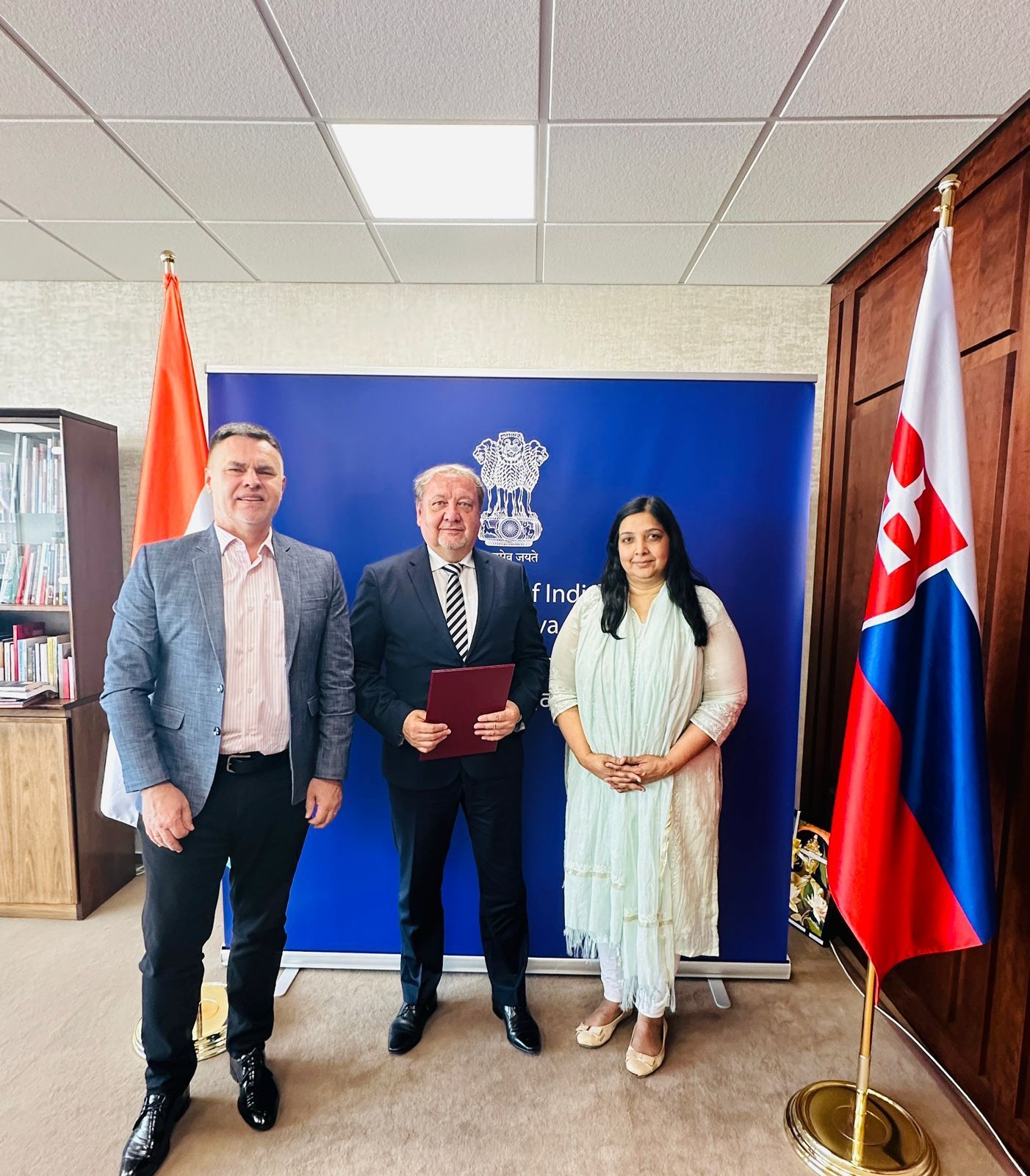
In the photo, from left:
Ambassador of the Slovak Republic to India Róbert Maxián, President of the Critical Infrastructure Association of the Slovak Republic Tibor Straka, and Ambassador of India to the Slovak Republic Apoorva Srivastava.The body content of your post goes here.
On behalf of the Slovak side, the Memorandum was signed by Tibor Straka, President of the Critical Infrastructure Association of the Slovak Republic, and on behalf of the Indian side by Rajkumar Upadhyay, Director General of C-DOT.
The agreement opens up space for the development of joint solutions in the field of cybersecurity and quantum-resistant cryptography. It focuses in particular on protecting systems that form the foundation of the digital economy and critical infrastructure. The aim of the cooperation is to strengthen the resilience of these systems in the face of growing cyber threats and technological changes, including the emergence of quantum computing.
The cooperation builds on the developing technological dialogue between Slovakia and India in the areas of digital technologies, cybersecurity, and the resilience of critical infrastructure.
The significance of the Memorandum of Understanding between AKI SR and C-DOT is also confirmed by the official Joint Statement of the Slovak Republic and the Republic of India, adopted on the occasion of the visit of the Prime Minister of the Republic of India to Slovakia on 15 June 2026. Its exact wording states:
“The Leaders acknowledged the growing importance of strengthening cooperation in the field of disaster risk reduction and resilience building and agreed to expand cooperation in the areas of resilient infrastructure, capacity building, knowledge exchange and institutional cooperation. The Leaders agreed to enhance cooperation in the protection of critical information infrastructure and in the prevention of and fight against cybercrime, while supporting an open, secure, accessible, stable, interoperable, resilient and peaceful digital space. The Leaders also expressed their determination to support each other in protecting information technology systems against emerging quantum threats to cryptographic systems, including through preparedness for the transition to post-quantum security. In this context, they noted that such cooperation would be further facilitated by the Memorandum of Cooperation signed in the area of critical infrastructure protection and post-quantum cryptography.”
The quoted provision of the Joint Statement places the Memorandum among the concrete instruments for implementing the strategic priorities agreed by the Prime Ministers of the Slovak Republic and the Republic of India, and creates a solid foundation for long-term cooperation in the fields of critical infrastructure protection, post-quantum cryptography, and building digital resilience.
The entire process of preparing the Memorandum of Understanding between AKI SR and C-DOT was systematically supported by the Ministry of Foreign and European Affairs of the Slovak Republic and coordinated through the diplomatic missions of both countries.
On this occasion, AKI SR expresses special thanks to Rastislav Chovanec, State Secretary of the Ministry of Foreign and European Affairs of the Slovak Republic; Apoorva Srivastava, Ambassador of the Republic of India to the Slovak Republic; and Róbert Maxián, Ambassador of the Slovak Republic to India, for their exceptional personal contribution, support, and initiative. Their active efforts significantly contributed to creating the conditions for this strategic cooperation and to strengthening mutual relations between the Slovak Republic and the Republic of India in the field of advanced technological solutions.
“In the digital world, distance ceases to matter. What matters is when partners with a shared vision and determination come together to seek new, reliable and secure solutions,” said Tibor Straka, President of the Critical Infrastructure Association of the Slovak Republic.
The cooperation is based on connecting expert and technological capacities. The Slovak Republic brings, in particular, specialized expertise in the field of post-quantum cryptography and critical infrastructure protection, which will be implemented at the application level primarily by Decent Cybersecurity. The company is among the established innovators in post-quantum cryptography at the international level and is one of the founding members of AKI SR. It operates in the Indian market through its subsidiary, Arkanum Deeptech Private Limited.
India enters the partnership as a major technological player with extensive scientific and research capacity under the strategic National Quantum Mission programme, and with the ambition to become one of the world’s leading countries in this field.
By concluding the Memorandum of Understanding, Slovakia and India are entering into cooperation that may have a real impact on how digital systems and critical infrastructure will be protected globally in the future. At the same time, it represents a new milestone in the development of the strategic partnership between the two countries in the areas of digital security, quantum technologies, and building a resilient digital future.