Gas as a Test of Slovakia's Resilience: Energy Security Does Not End with the Price of the Commodity
The upcoming heating season is a reminder that security of energy supply is not merely a question of the market. The Echo24 portal has drawn attention to an analysis by Oxford Economics, according to which this may be the European Union's most demanding winter in terms of energy supply since the crisis period of 2021–2022. The reasons cited are a combination of slower filling of storage facilities, geopolitical risks, supply outages, drought affecting electricity generation, and higher demand for gas in the power sector.
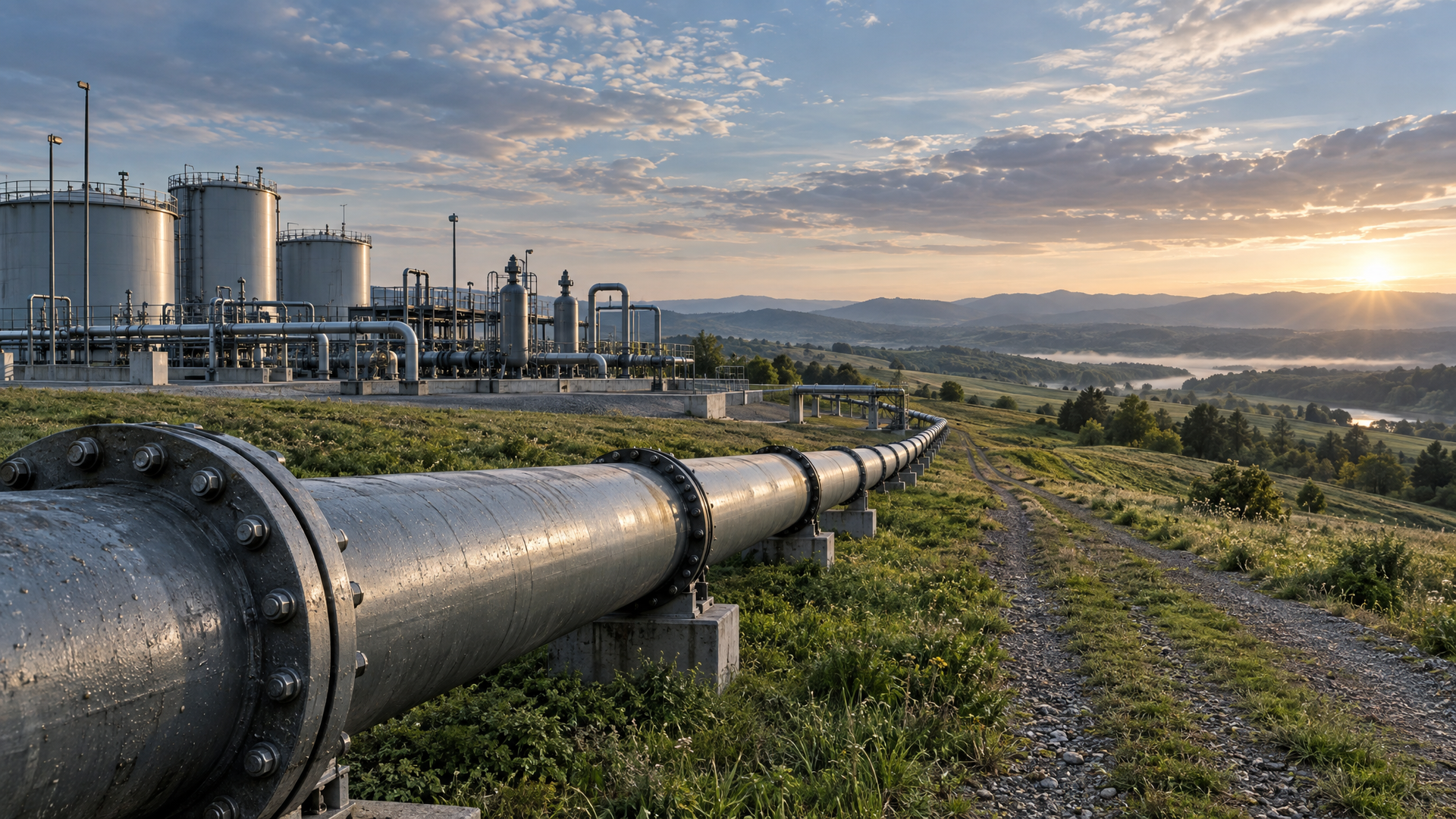
For Slovakia, this is not a distant European debate. Natural gas is an input for heating households, operating hospitals, public buildings, district heating and industrial production, where in certain technological processes it has no full-fledged alternative. It is therefore not merely a commodity. Gas infrastructure ranks among the key elements of the critical infrastructure of the Slovak Republic.
Slovakia has strong infrastructural foundations
Slovakia has a well-developed transmission and distribution network and significant underground gas storage facilities. These even out the difference between summer and winter consumption, cover peak withdrawals during frosts and provide the system with flexibility.
The storage facilities are operated primarily by NAFTA and POZAGAS. NAFTA reports a storage capacity of approximately 27.7 TWh of working gas volume, while POZAGAS at the Láb site reports approximately 6.9 TWh. Together this amounts to more than 34 TWh, which for a country the size of Slovakia is a strategically significant capacity with regional reach.
Storage facilities are not, however, a universal insurance policy. In assessing their contribution, it is not enough to track the volume of gas stored. Equally decisive is the storage facility's maximum daily withdrawal capacity — that is, the ability to deliver gas into the network quickly enough during a prolonged cold spell, when consumption rises abruptly. A full storage facility with limited withdrawal capacity may not cover an extreme peak as reliably as the fill percentage alone would suggest.
Critical infrastructure is not just pipelines
Public debate tends to focus on the storage fill percentage and the price per megawatt-hour. From a critical infrastructure perspective, the picture is broader: it encompasses transmission and distribution networks, compressor stations, regulating and metering stations, dispatch centres, industrial control systems such as SCADA, cross-border interconnections, balancing and trading mechanisms, cybersecurity and crisis planning.
If winter brings a combination of hard frosts, a supply outage and a price shock, it is not enough that gas exists somewhere in the system. It must be available at the right time, in the right volume and at the right pressure — and for those customers who are a priority in terms of the public interest. This is precisely why the gas sector has established demand-restriction regimes and a categorisation of protected customers — instruments that work only if they are prepared, tested and clearly understood by all parties in advance.
The current legal framework reflects this approach. Act No. 367/2024 Coll. on Critical Infrastructure, effective from 1 January 2025, replaced the original Act No. 45/2011 Coll. and transposed Directive (EU) 2022/2557 of the European Parliament and of the Council on the resilience of critical entities (the CER Directive). The essential shift lies in the very logic of protection: from the physical security of an individual element to safeguarding the continuity of an essential service. The Act introduces the concepts of critical entity and essential service, and imposes obligations to assess risks, adopt a security plan and report incidents. Its annex lists the gas sector as a sub-sector of energy, with essential services including the supply, distribution, transmission and storage of gas, the operation of LNG facilities, and the extraction and processing of natural gas. This is therefore an area to which the new legislation applies directly and across the entire value chain.
Critical infrastructure cannot be assessed in sectoral isolation
This is one of the principal professional positions long advocated by the Critical Infrastructure Association of the Slovak Republic. Energy, transport, healthcare, water management, digital infrastructure, the financial sector and public administration are not separate worlds. They are linked by interdependencies that are practically invisible under normal conditions and become apparent only at the moment of an incident.
The example is straightforward: a restriction of gas supply affects district heating; that in turn affects the operation of healthcare and social care facilities; these depend on electricity and telecommunications, which are themselves indispensable for managing the energy system itself. What arises is a so-called cross-dependency, in which the impact does not spread linearly but in cascades. Sectoral risk assessment generally fails to capture it, because each sector evaluates only its own perimeter, and the boundaries of responsibility end precisely where the dependency continues.
The Association therefore approaches critical infrastructure comprehensively and in context — at the level of the links between sectors, not as an isolated list of them. The aim is to identify those dependencies that belong unambiguously to no single sector and therefore remain without a systematic owner.
A lesson from the crisis: the cheapest solution is not necessarily the safest
The energy crisis after 2021 demonstrated that one-sided dependency is not only a commercial but also a security risk. The European Union subsequently adopted rules on the filling of storage facilities, and the European Commission emphasises that gas storage is an important instrument of security of supply, as it helps cover a significant part of winter consumption.
Formal fill targets, however, do not in themselves guarantee preparedness. If storage facilities fill more slowly because of weaker commercial incentives for traders, if global competition for LNG intensifies, or if extreme weather drives consumption up, the risk returns — not necessarily as a physical shortage, but as pronounced and unpredictable price swings and pressure on vulnerable customers.
Supply chains: the least visible yet decisive component of resilience
In the energy sector, attention naturally focuses on the commodity supplier and the transport route. In practice, however, operational continuity is determined by the entire supply chain: technology servicing, spare parts and specialised components, metering equipment, industrial control systems and their software, telecommunications connectivity, cyber services, physical protection of facilities, logistics and the availability of qualified personnel.
Why does this matter?
Because infrastructure may have sufficient commodity supply and still run into trouble. If a specialised component or service is unavailable, if a cyber service provider fails, or if a logistics route is disrupted, the operational impact can be just as severe as if the gas itself were missing. Moreover, the vulnerability often lies not with the main supplier but deep within a sub-supplier structure that the operator has not mapped. Supply chains today are global and, in the case of specialised industrial technologies, heavily concentrated — a single manufacturer may serve the majority of the European market.
Alongside technical and logistical factors, a further dimension has taken on decisive importance in recent years:
- Political and geopolitical decisions. Sanctions regimes, export controls, restrictions on the export of strategic materials and technologies, or shifts in trade policy can make a previously trouble-free delivery impossible overnight. The risk arises not from a malfunction, but from a decision.
- Armed conflict and disruption of transport routes. The war in Ukraine, as well as tensions around key maritime corridors, have shown that conflict affects not only commodity sources but also logistics, the availability of insurance, production capacity and input prices. Restricting a single corridor has an immediate impact on the availability of both components and energy.
- The regulatory environment. New environmental, safety, certification or cyber requirements alter the pool of eligible suppliers. A change of law in a third country can disqualify a sub-supplier on which the operation of a facility in Europe depends.
- Ownership and jurisdictional dependencies. What matters is not only what a supplier delivers, but also who owns it, which legal order it is subject to, and what access it has to the operator's data and control systems.
- Hybrid activity. The supply chain is increasingly a vector of attack. Compromising a software or remote-service provider can grant access to operational systems without any physical intervention in the infrastructure.
The monitoring and analysis of supply chains is therefore one of the principal professional priorities of the Critical Infrastructure Association of the Slovak Republic. This is systematic work: identifying the critical dependencies of critical infrastructure elements, tracking supplier concentration, evaluating geographical, political and technological risks, and seeking alternative solutions before a crisis arises.
The Association is deliberately building professional capacity in this field. This is exceptionally necessary, because supply chain analysis requires a combination of technical, security, economic, geopolitical and legal expertise, and in Slovakia it is a competence that needs to be strengthened systematically rather than improvised during a crisis. Alongside this priority, the Association also supports professional debate, cooperation among operators, the state and local government, and raising awareness of critical infrastructure protection.
"Energy security does not begin on the day a crisis strikes. It begins in the supply chains — in whether we know our own dependencies, and whether servicing, components and people are available to us. That is why, within the Association, we are building professional capacity for the monitoring and analysis of supply chains. It is one of the areas where Slovakia needs systematic work, not improvisation," says Tibor Straka, President of the Critical Infrastructure Association of the Slovak Republic.
What Slovakia should be watching ahead of every winter
Before the heating season, general assurances that there is enough gas should not suffice. The more specific questions are what matter:
What volume of gas is genuinely available to Slovak customers, and what is the maximum daily withdrawal capacity of the storage facilities?
How reliable are the main supply routes, and how would the system respond to a prolonged cold spell?
Which customers are given priority in the event of crisis-driven supply restrictions, and is this categorisation up to date?
Have the key supplier and sub-supplier dependencies been mapped, including political and jurisdictional risks?
Are physical protection and cybersecurity addressed as a single whole, including hybrid scenarios?
Are crisis plans tested across sectors — that is, jointly with the energy sector, telecommunications, healthcare and local government?
Winter as a recurring test of the state's resilience
In the field of gas, Slovakia has sound infrastructural foundations: storage capacity, network interconnections and experience from previous crises. Energy security, however, cannot be understood statically. It is not a snapshot of a full storage facility on a single day, but the system's ability to withstand weather fluctuations, price shocks, cyber incidents and failures in supply chains.
Winter tests not only energy markets but also states. For Slovakia, every heating season should therefore also serve as a regular test of the resilience of critical infrastructure — assessed comprehensively and in context, not sector by sector.