Without Raw Materials There Is No Resilient Infrastructure. Why a Neglected Raw Materials Strategy Concerns All of Us
The debate on critical infrastructure in Slovakia centres on electricity, networks and data. Its deepest layer — raw materials — remains outside the spotlight. The document meant to determine how the state handles its mineral wealth works with data from 1999, and its projections end in 2010. The Critical Infrastructure Association of the Slovak Republic and experts from the Faculty of Mining, Ecology, Process Control and Geotechnologies of the Technical University of Košice (FBERG TUKE) therefore say one thing: without raw materials security there is no secure state either.
A Neglected Document That Was Meant to Set the Course
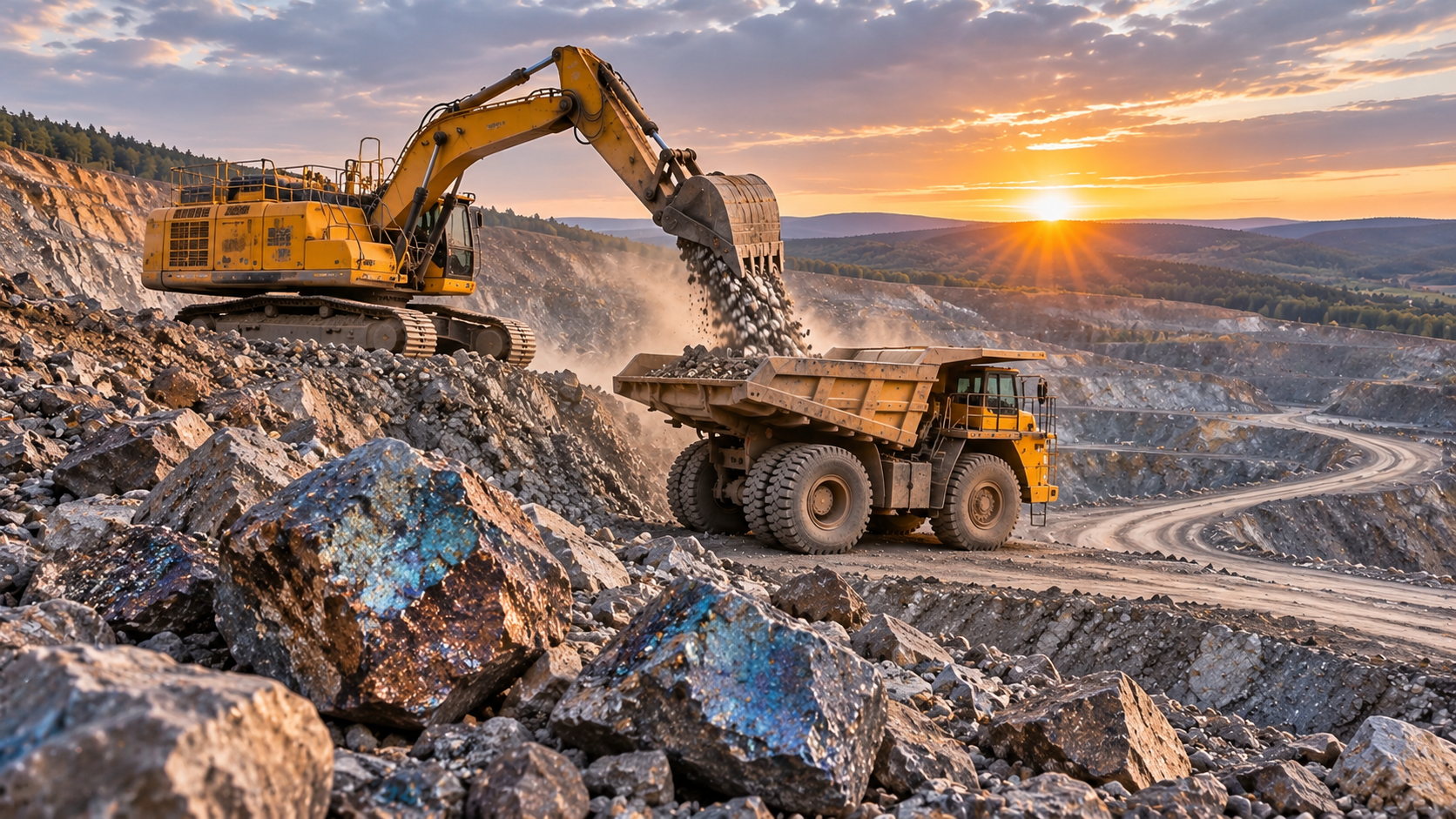
Experts from FBERG TUKE pointed out that the 2004 state document on raw materials works with figures from 1999, and some of its projections reach only as far as 2010. It was drafted at a time when the state was rather scaling mining down and addressed recycling practically only in construction waste. The faculty took part in preparing a new raw materials policy plan, which places raw materials security first — that is, a state in which the state has raw materials available in the quality and quantity it needs, and at the time it needs them (Korzár SME).
The faculty's wording is matter-of-fact and uncomfortably precise: "The fact that this strategic document uses statistical data from 1999 proves that its updating and adaptation to the latest trends is absolutely necessary" (translated from Slovak). This is not an academic remark. A document that was supposed to define where and under what conditions the state will mine, what it will recycle and what it will depend on has in the meantime become a historical text. Under Article 4 of the Constitution of the Slovak Republic, mineral wealth belongs to the state and cannot be renewed; it must therefore be protected and used sparingly, in the interest of present and future generations.
Statement of the Critical Infrastructure Association of the Slovak Republic
The Critical Infrastructure Association of the Slovak Republic (AKI SR) sees raw materials security as an entry condition for resilience, not as a parallel agenda. Its president, Tibor Straka, repeatedly stresses that critical infrastructure is not a technical matter confined to the grounds of a power plant or a data centre: "Critical infrastructure is the basic skeleton of the country. Disrupting it does not mean merely a technical problem, but an intervention in people's everyday lives and in the functioning of the economy" (SITA) (translated from Slovak). According to the association, coordinated cooperation between the state, municipalities and the private sector is essential.
AKI SR was established in 2025 as an independent, non-political professional platform bringing together critical entities, their suppliers, professional organisations and the academic community; it works closely with the National Security Office and the Ministry of the Interior of the Slovak Republic (teraz.sk). Its substantive framework is set by Act No. 367/2024 Coll. on critical infrastructure, which as of 1 January 2025 defines eleven sectors. Raw materials are not one of these sectors. They are an input into almost all of them.
"True resilience is not created by adopting a single document or by formally meeting the requirements of the law. It requires systematic risk management, expertise and continuous work. That is precisely where we want to be a partner to our members," says Tibor Straka, President of the Critical Infrastructure Association of the Slovak Republic.
This position can also be read as an answer to the raw materials question. Just as adopting a critical infrastructure act is not enough, neither is adopting a new raw materials policy. What is decisive is the ability to turn a document into managed risk: to know which raw materials are strategic, where they come from, who processes them, what happens if a supplier fails, and how quickly an essential service can be restored.
Analysis from the Critical Infrastructure Perspective: Where the Professional Contribution Arises
The first shift lies in a change of optics. Raw materials policy has traditionally been read as an economic and environmental topic: mining, permits, waste, landscape. The critical infrastructure lens adds a third dimension: the continuity of essential services. The question shifts from "do we have enough raw materials?" to "which essential service will stop working if a raw material is unavailable or its processing is interrupted?" For energy this means fuels and components, for transport maintenance materials and spare parts, for healthcare specific inputs and devices, for digital infrastructure critical minerals and semiconductors, for food fertilisers and packaging. Criticality is not tied to a deposit but to a chain.
The second shift lies in the transmission of criticality through the supply chain. The new act explicitly obliges critical entities to assess supply chain risks, including suppliers' risk profiles and the identification of strategic dependencies. Companies that mine, process, import or distribute raw materials cease to be "merely" suppliers and become part of their customers' security ecosystem; the ability to demonstrate reliability and resilience becomes a market advantage rather than an administrative burden.
The third shift lies in temporal asymmetry. Critical infrastructure is measured in hours to recovery, raw materials policy in decades to opening a deposit. A state without a raw materials strategy cannot "mine more quickly" in a crisis. It can only react to the consequences. It is precisely this scenario that the new policy identifies as a greater risk than sanctions for non-compliance.
The fourth shift lies in the cascading nature of failure. Tibor Straka highlighted this when assessing European incidents: "Europe faces growing pressure on critical infrastructure. Attacks that often have no clear originator and no unambiguous motive are becoming an instrument for destabilising states. Without borders and without warning" (teraz.sk). A power outage halts production, restricts transport and disrupts services; disruption of a logistics hub causes delays across countries; a problem in data infrastructure is immediately reflected in financial operations. A raw materials outage follows the same logic, only with a longer delay: it manifests itself only at the moment when there is no longer anything to replace the shortfall with. The new policy therefore introduces a circular model: instead of the extract — consume — discard scheme, recycling and reuse are to come in. From a resilience perspective this is a strategic reserve on the state's territory that shortens supply routes. However, recycling will not replace primary sources for all commodities, and it must therefore be part of the portfolio, not its replacement.
The fifth shift lies in social legitimacy and human capacities. Many people distrust mining, which is why an open dialogue with conservationists and the residents of affected municipalities is needed. Trust is an essential condition for the successful planning and implementation of raw materials projects. Equally important are qualified experts for the entire process, from deposit exploration through mining and processing to recycling and nature protection. Without them, even a sound strategy will remain unexecutable.
Why This Matters
The question has three levels, and each concerns someone else.
For the citizen it matters because raw materials dependence does not manifest itself as mining but as price and availability — in the energy bill, in the supply of medicines, in whether transport works and whether there is food in the shops. Critical infrastructure is "the basic skeleton of the country", and raw materials are the material it is built from.
For the state it is about sovereignty in a practical, not declaratory sense. Mineral wealth belongs to the state and cannot be renewed; if the state does not handle it strategically, the result is not only an economic loss but a security gap. A document with data from 1999 and projections to 2010 does not fill that gap, it merely exposes it. A new policy that places security first is therefore less an update of a document and more a restoration of governing capacity.
For operators of critical entities it matters because the rules have already changed. A new regime of obligations applies to critical entities: regular risk assessment, a resilience plan, continuity of essential services, reporting of serious incidents and verification of the effectiveness of measures. Anyone unable to demonstrate management of raw materials and supply chain dependencies will not withstand this regime, even with formal compliance with everything the law requires.
And finally, Slovakia has real professional capacity in this area that it can turn into an advantage. AKI SR contributed expert input to the preparation of the Strategy for the Resilience of Critical Entities of the Slovak Republic and the National Cyber Security Strategy for 2026–2030, and by adopting the strategy Slovakia ranked among the first three EU countries to meet this obligation (teraz.sk). The same model — a professional platform linking the state, the academic community and industry — is available for raw materials policy as well. The question is therefore not whether we have the capacity, but whether we will use it before a crisis forces us to.
Source: Bez surovín nie je bezpečný štát. Košickí odborníci upozorňujú na zanedbanú stratégiu, Korzár SME, 30 October 2026.